Sunday, 26 June 2016

The basics of email marketing

The basics of email marketing

What is email marketing?

Email marketing comes in many shapes and forms. However, it’s basically this: every email you send to (possible) customers with the hopes of gaining or continuing their business. Most of the times, this comes down to newsletter marketing. You’re trying to sell your products or services through your daily/weekly/monthly newsletter.
However, for a lot of webshops, that’s not all the email marketing there is to it. At Yoast, we also send out emails when a customer’s license is about to expire, for example. And quite often, our email support is also a place where marketing happens.

Why you should be doing email marketing

For those of you not doing anything in email marketing yet, this one’s for you:
Email Marketing Revenue
Email marketing revenue by source
These are the stats for this year so far. As you can see, 23.1% of this year’s revenue has come from either email or newsletter. The only portion that’s bigger is the organic portion, which means traffic from search engines.
To my mind, this should be more than enough to convince you to start doing email marketing. But if you feel it’s not, here’s some more to convince you:
Content SEO eBook Revenue - Email Marketing
Content SEO eBook sales
That’s the revenue for our new Content SEO eBook. And guess when we released it? That’s right, on February 3rd. We announced the release on Facebook, Twitter, our own website and in our newsletter. So what worked best? Since the release of that eBook, over 75% of the revenue of this eBook has come from our newsletters.
And to top it off: the Return on Investment (ROI) was over 22,000%, since we earned back over 221 times what we invested. This is the total ROI, since we sold a lot more than just our second eBook from those two newsletters.
So email really is a great marketing tool. It keeps your brand on the minds of your (potential) customers. On top of that, it makes sure your new product launches won’t go unnoticed; the release notice is actually sent to a whole bunch of people that have already expressed interest in your business.

How to do email marketing

Now that you’re convinced you need to be doing something with this email marketing thing, let me tell you how I think you should go about it. So I’ll try taking a ‘start-to-finish’ approach.

Building your email list

The first and foremost thing to building your email list is to make it as easy as possible to sign up. And as easy as possible means, for example, cutting down on the signup form fields:
newsletter signup example - email marketing
Real-life newsletter signup example
This is a real live example we’ve encountered in our Website Reviews a while back. This is simply not how you do this. You should ask for just the most necessary, which is just the email address to be honest. You really do not need anything else. On yoast.com we ask for just an email address and we’re getting over a 1000 new subscribers every week.
Next to keeping it simple, it also helps showing your signup form to people when they’re engaged on your website. We’ve done this by using a little box that slides up as the user scrolls past a threshold. If you’re using WordPress, there’s an awesome plugin by our friend Danny calledScroll Triggered Boxes that’ll make this easy as pie to set up. Other engaged visitors are people who actually buy your products, so be sure to have a signup in your checkout as well!
Of course there are a lot of other things you could try, such as a HelloBar, a static signup in your sidebar, a Twitter campaign for your email list. I do have to say though, the Twitter campaign wasn’t successful at all in our case. However, we try to keep it all as non-obtrusive as possible on yoast.com. We don’t want people to get annoyed by our signup forms, even though that would probably get us an even higher success rate.

Think about deliverability

Once your email list starts growing, you should really start thinking about deliverability. What I mean by this is the percentage of emails that are actually getting to the people in your email list. Simply sending your newsletter from your WordPress admin won’t cut it, most of the time. You have a good chance your emails are actually ending up in people’s spam folders. And that’s a real shame, because people won’t even know you sent an email in the first place!
If you’re using a service such as MailChimp it’s easy enough to increase your deliverability. MailChimp has a simple checkbox to authenticate your campaign. There are four types of authentication and checking this box in MailChimp will enable all four of them by default. So my advice is to really start using an email service such as this. It doesn’t have to be MailChimp, as long as you’re sure to check for such deliverability options.

Keep your email’s content engaging

One of the most important things to do is to keep your email’s content engaging. People should want to read your newsletters or other emails. This comes down to keeping a healthy balance between promotional and informational content. This can be a fine line to walk, but it’s well worth the effort. Let me give you some tips how you can keep your readers engaged:
  • Be personal; keeping a personal tone tends to resonate more with your following and seems to increase click ratios as well;
  • Interact with your following; you can do this by asking for feedback, give them special discounts or saying thanks to them (which can be combined with discounts);
  • Make announcements; whether this is about a new product or service, or about something noteworthy within your line of work (f.i. we usually highlight any big Google changes in our newsletter), keeping your following up to date and sharing news worthy items really helps increase their engagement;
  • Share your knowledge; I feel this is probably the most important one. Sharing your knowledge makes for worthwhile emails for your following, but it also shows them you know what you’re doing. So not only do they get more informed, their trust in your brand will increase.

Make your emails mobile friendly

Mobile is really growing in the email market, with almost 50% of all newsletters being opened on mobile. So you should really make sure your newsletter is as mobile friendly as possible. A lot of the mailing services offer default templates that are mobile friendly and will scale down nicely. If you don’t want to spend too much time or money on your newsletter at first, this is a good option.
Another thing to take into account with mobile emails, is your subject line. Since mobile screens are obviously not as wide as desktop screens, your subject lines might not actually fit the screen. This might not be a problem at all, but it’s a good one to keep in mind. It could be a good idea to test this.

A/B test your emails

Since every company is different and therefore your clients probably differ a lot from ours, or at least they expect something different, it’s important to test. Don’t just assume that what’s been working for others will work for you.
All of the mailing services I’ve checked out offer A/B testing on the subject. And that’s a great way to test which subject line gives you the highest open rate. That’s a great first step for optimization. However, not a lot of them offer A/B testing on the content (body) of an email. And that’s obviously the best way to know how to optimize your text for a higher click rate.
While you’re at it, it’s probably also a good idea to test how often you should ideally be sending emails to your customers. This is again a fine line to walk, since you’re in danger of sending it too often for at least a portion of your following. And while we’re talking timing, also think about the time you’re sending out your emails!

Tag your email links

Some mailing services offer this as well, but we still tag the links in our emails by hand, because we want to do it a particular way: custom campaigns. As I also explained in that post, custom campaigns are a way to “tag” your links so you can easily find them in your Google Analytics. This way you know exactly what traffic and sales came from your newsletters. This is also the way I could tell you our ROI on our newsletters earlier in this post.

To conclude

Next week I’ll be doing a post on email marketing for ecommerce websites. This will go into creating repeating customers and regaining lost customers using email.
For now, this is it! What do you think? Are you missing anything in here you think is really important? Let me know in the comments!
Reference:https://yoast.com/basics-email-marketing/

What is Affiliate Marketing?

What is Affiliate Marketing & FAQ

What is Affiliate Marketing
Whenever I publish my income report or share how I earn money with my blog, I often use the term “affiliate marketing”. Bloggers and internet marketers who have been into online marketing for years are familiar with affiliate marketing, and with the fact that it is the most lucrative way to earn money online.
In this article, I will share the basics of affiliate marketing and all the details you need to know in order to understand how affiliate marketing works.
Learn all about Affiliate marketing in one eBook : Buy from ShoutMeLoud store

Affiliate Marketing Explained: What is affiliate marketing ?

Affiliate marketing is one of the oldest forms of marketing wherein you refer someone to any online product and when that person buys the product based on your recommendation, you receive a commission. This commission varies from $1 to $10000, depending on what product you are promoting.
This commission varies from $1 to $10000, depending on what product you are promoting.
What is Affiliate Marketing
The most common question I hear is related to how companies track the record of who is sending the traffic and making the sales. The simple answer involves a tracking URL, which is a unique link given to you by the affiliate company or product company.
This URL is used to keep track of all the traffic and sales you are making via your website or other promotional techniques. Many old-fashioned affiliate programs allow a buyer to add the email or referral details in an effort to account for affiliate sales, but this is certainly not the best way to track progress.
So, in simple words:
Many online companies who sell products such as shoes, web-hosting space or any service, offer an affiliate program. You can simply sign up for the program and get your unique tracking link. Now, whenever you are writing about the product, you can simply use this special tracking affiliate link to recommend the company’s site, and if your readers buy anything, you will get a commission.
Every affiliate program has a set TOS.  For example, many of them offer a 60-day cookie period, which  means that if a visitor uses your special affiliate link to land on the sales page of the site and instead of buying today, he buys at some point within the next 60 days, you will be entitled to the sales commission.
Following are some of the common terms associated with affiliate marketing:
  • Affiliates: Publishers like you and me who are using affiliate program links to promote and make sales.
  • Affiliate marketplace: There are many marketplaces like Shareasale,CJ and Clickbank, which work as central databases for affiliate programs in different niches.
  • Affiliate software: Software used by companies to create an affiliate program for their product, for example: iDevaffiliate.
  • Affiliate link: Special tracking link offered by your affiliate program to track the progress of your affiliate promotion.
  • Affiliate ID: Similar to the affiliate link, but many affiliate programs offer a unique ID which you can add to any page of the product site.
  • Payment mode: Different affiliate programs offer different methods of payment. For example: check, wire transfer, Paypal and many more.
  • Affiliate Manager/OPM: Many companies have dedicated affiliate managers to help publishers to earn more by giving them optimization tips.
  • Commission percentage/amount: The amount or percentage you will be receiving in affiliate income from every sale.
  • 2-tier affiliate marketing: This is a great way of making money from an affiliate program. With this method you recommend that others join affiliate programs, and you receive a commission when a sub-affiliate makes a sale, (similar to MLM or multi-level marketing.) This income is popularly known as sub-affiliate commission.
  • Landing pages: A unique product sales or demo page used for the purpose of increasing sales. Most of the programs that you will be promoting have many landing pages, and you can run A/B testing to see which pages convert best for you.
  • Custom affiliate income/ account: Unlike a generic affiliate account, many companies offer custom affiliate income to people making the most affiliate sales for them.
  • Link clocking: Most of the affiliate tracking links are ugly. Using a link clocking technique like URL shorteners, Thirsty Affiliates, etc., you can turn ugly links into links that can be read and understood by your readers.
  • Custom coupons: Many programs allow affiliates to create custom coupons which are also used to track sales. Custom discount coupons help you to increase affiliate sales as well.
For companies offering an affiliate program, this is one of the best ways to receive free promotion, thus saving substantially on advertising. For example, whenever you see coupons or discount links, most of the time these are affiliate links, and when you make a purchase, web-masters make money.

Affiliate marketing :: FAQ

At this point, you should have a basic understanding of what affiliate marketing is and how it works. If you have any questions regarding any of this, you can always ask it in the comments section below.
Now, let me answer some of the common questions asked by web-masters and marketers where affiliate marketing is concerned:
Is affiliate marketing harmful or illegal?
No, it is neither harmful nor illegal, as you will simply be using the particular link provided to you rather than a direct link to link to any site.
Affiliate marketing and AdSense: Can we use both?
Yes, you can because affiliate marketing does not violate any Adsense TOS. In fact, for me affiliate marketing works better than Adsense, and that is one reason you see fewer AdSense ads here at ShoutMeLoud.
How do I find an affiliate link for any product?
Not all companies offer an affiliate program, of course, but for those that do offer affiliate programs, you can check their website for related information. When searching, be sure to check the company’s FAQ page if they have one.
Another way find this information to do a simple Google search. For example, one could place the following phrase into the Google search engine:  “product name + affiliate program“. Replace product name with the name of the product you are promoting, and this should bring you to the landing page. Many companies use an affiliate marketplace like ShareASale, CJ, or Clickbank. These are free to use and allow you to create a free account.
How to find new products to promote?
Affiliate marketplaces such as those mentioned above are the best places to start your affiliate marketing research. You can browse your niche and see the top performing affiliate programs
Alternatively, you can keep an eye on blogs in your niche and see which products they are promoting and what methods they are using.
Is it important to have a blog for affiliate promotion?
Not necessarily, however a blog is really the best promotional tool. With that said, you can always use methods such as PPC or advertising to promote a product as well. This is more like hit-and-run affiliate marketing however.  The best way to make the most of your affiliate marketing opportunities is to have a blog and use it for hard and soft promotion.
How much does it cost to join an affiliate program?
There is no charge for joining an affiliate program, however your total cost depends on what promotion technique you are using. For example, a blog post doesn’t cost a dime whereas PPC marketing, email marketing or advertising come with various price tags.
What qualifications do I need to become an affiliate marketer?
There is literally no qualification required to become an affiliate marketer, though having good copywriting skills and marketing skills will be an added advantage.
Are there programs available which automatically converts links into affiliate links?
There are a few networks like Viglink and Skimlinks which automatically convert normal links into affiliate links. They use Javascript so it’s SEO friendly, and you do not need to sign up for an individual affiliate program.
How much money can one make from affiliate marketing?
As I mentioned above, there is no limit to the amount of money you can earn from affiliate programs. It all depends on which program you’re promoting and how much conversion you are making. I started with $47 as my first affiliate income, and now I make almost $4k-5K/month by promoting products which I use day-to-day.
Alright, I now understand what affiliate marketing is all about.  How do I get started?
Here at ShoutMeLoud, I and many guest authors have covered some of the best guides to help you to understand in depth about getting started, and some of the pros and cons. Following is a list from our affiliate marketing archive which will help you to get started:
I hope this beginner’s guide to affiliate marketing will help you to get started. If you have any additional questions, feel free to ask me in the comments section below.
Be sure to  join my email newsletter to get many more similar tips and updates. If you find this article informative, do share it on Facebook and Google+.
Check your domain ranking
Authored By 
Harsh Agrawal is the founder & CEO of ShoutDreams. Over the last 7 years, he & his team has proved the way to turn blogging into a lucrative career choice. A blog scientist by mind and a passionate blogger by heart. His blog, ShoutMeLoud receives 1 million Pageviews/month and has over 832K subscribers.

Reference:http://www.shoutmeloud.com/what-is-affiliate-marketing.html

Wednesday, 22 June 2016

Improve Content Quality Using Metrics That Matter for SEO

.Search Engine Optimization is about making search engines aware that your website’s pages are interesting and relevant—and more so than other websites.
You are well aware of how important providing high-quality content is – “The single most important thing to do” says Google, but how do you measure it?
Here are suggestions of meaningful metrics and how to use them:

Remove the Template From the Equation

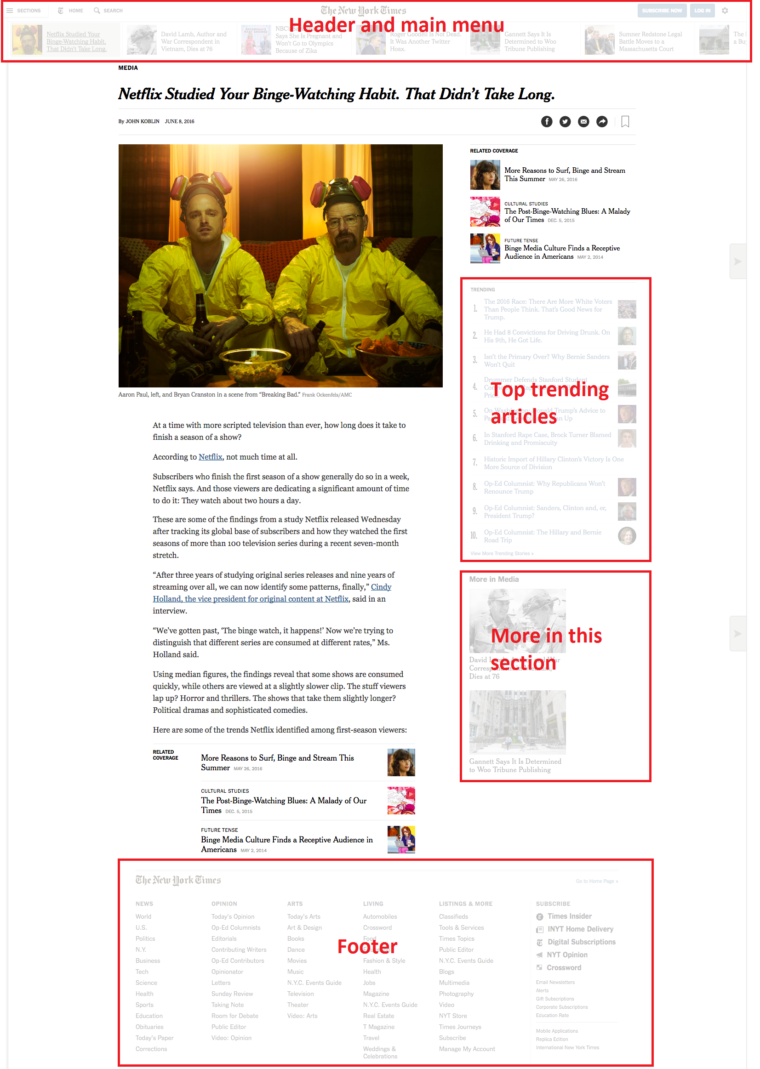
First, it is necessary to remove the “noise around the signal”: ignore all that is not directly related to the page’s core content – the page topic – that is to say, disregard the page template.
Typically, the template will include generic elements such as a header, footer, and main menu. Other elements may also qualify as a template, when common to a large number of pages: for instance, a Reuters feed on a news website, or the latest arrivals on an e-commerce website.
The example below shows that the template can easily represent a significant portion of all words found on a page:
content_vs_template
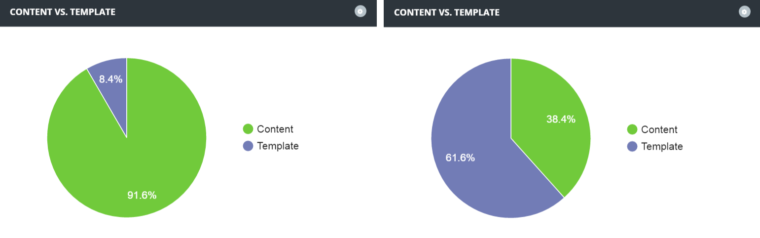
Template weight may also prompt an action point. Is it overwhelming? It may deserve to be reduced. See these examples of two publishing websites:
Botify-content-vs-template_226053187

Look at the Size of the Actual Content, in Words

Once templating is put aside, we can look at the size of the actual content, in words. This accurately reflects the user’s perception: how much is there to dig their teeth into, how much corresponds to what they came to the page for?

Pinpoint Thin Content and Define Content Size Goals

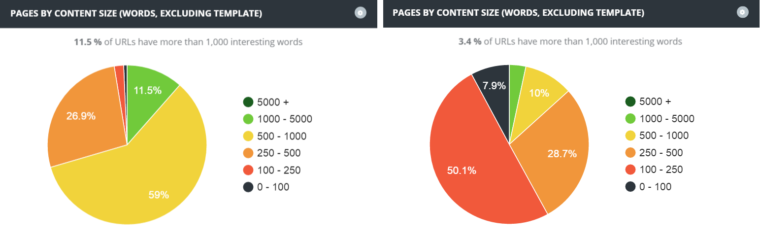
Each website will be able to assess the situation and define goals, by page type. A publishing website may aim at 500 to 5,000 words for article pages; an e-commerce website could estimate that 250 words are acceptable for product pages, while another with very specialized products may want more.
Here are examples of content size distribution on two publishing websites:
Botify-size-in-words-without-template_226053178

Check Pages’ Added Value

Taking on the task of assessing how valuable a page’s content is requires more than identifying near-duplicates.
Rather, the question is how much unique content, found nowhere else on the website, does it contain? This is about information, ‘information’ being a sequence of words (n-gram, for the tech-savvy). Many pages will have *some* information in common, as they belong to the same website, the same semantic universe. But the more there is in common, the less added value each page has.

How Close is the Most Similar Page?

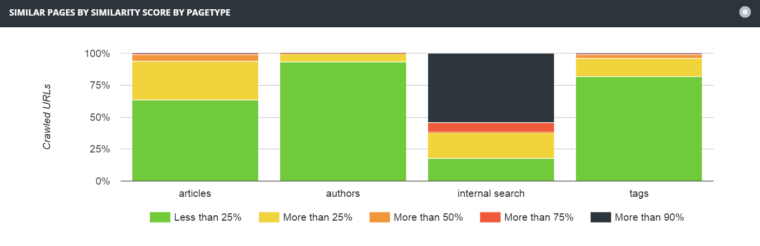
Which proportion of its actual content – template excluded – does a page share with the page that is most similar?
In the example below, most internal search pages provide very little added value, as they share most of their content with other pages. It turns out that some are very similar to category pages, others to search results with similar queries. Action point: consolidate.
Botify-similar-pages-by-pagetype_226053184

How Big is Each Cluster of Similar Pages?

The additional metric to look at is how many pages each group of similar pages contains. Like everything with SEO, your task is now to look for the biggest wins and prioritize.

Going Further

These metrics are also very useful to:
  • Analyze a website you are not familiar with, as an SEO consultant approaching prospects
  • Compare your website to the competition
  • Monitor content changes on your website

Check how your website performs according to these criteria. Try Botify!

Botify is an SEO analytics platform based on a website crawler, which received the European Search Award 2016 for “Best Search Software Tool”. Ask for a free, full-featured 30-day trial.
Reference:https://www.searchenginejournal.com/improve-content-quality-using-metrics-matter-seo/165145/

What is Digital Marketing? The entire online marketing course content?

LEARN THE ENTIRE DIGITAL MARKETING  

BE A PROFESSIONAL  MARKETER  

!!!!!!!!!!!!!!! HEY GUYS !!!!!!!!!!!!!!!!!!!!


If you want to become digital marketing professional following topics you must study so keep researching on these topics because digital marketing is not the stable technology it is keep changing with the discovery of new technology, this industry can never be firm so be updated and be ahead of others.

keep researching on the following topics

Overview of Digital Marketing

  • Differences between Digital marketing and Traditional Marketing
  • Importance of Market Research and analysis.
  • Difference between Promotion and Advertising.
  • What is Traffic, how to bring Targeted Traffic.
  • How to market your business online?
  • Importance of Visibility and Engagement?
  • Inbound marketing is the need of the hour.
  • What is a Lead?
  • What is Lead Nurturing.
  • Overview of how to generate leads for your business.
  • What is CTA and why it’s important.
  • What is Google Indexing?
  • What is SERP?
  • What is Bounce Rate ?
  • Inorganic and Organic search?
  • Understanding the functionality of Search Engines.
  • What are Web Crawlers?
  • Understanding what are keywords and how to use them wisely?
  • What is White Hat, Black hat and grey hat in Internet marketing.
  • Performance evaluation is key.
  • Understanding ROI

Website Planning & Creation

  • Understanding various types of websites.
  • What is Web Hosting?
  • what are Name Servers?
  • what are Domain Names?
  • What is EMD domain?
  • What are CMS Platforms.
  • Making a Website layout.
  • Building a Website using the most popular CMS Platform.
  • Creating Website Pages.
  • Adding logo to the website.
  • Adding a favicon to your website.
  • Some tips and tricks on how to get good content for your website?
  • How to add free quality images to the website.
  • How to add clickable buttons on the website.
  • How to use themes and plug ins?
  • Understanding the difference between pages and posts in a website
  • Adding social Share buttons on the website ( Facebook, Linked in, Twitter Google Plus etc)

E-Commerce & Marketplace

  • E-commerce structure
  • Key Differences between, E commerce, Marketplace and Affiliate Marketing
  • Various Components required to set up E commerce business
  • Best practices for Logistics.
  • What is a payment gateway
  • Importance of choosing the right payment gateway
  • How to become a seller on various e commerce platforms
  • Key points to keep in mind before becoming a seller
  • ROI structure and planning
  • E-Commerce Plugins and Themes
  • Overview of SEO for E-Commerce
  • Designing and development
  • Exploring SAAS Platform for building an E commerce website

SEO (Search Engine Optimization)

  • What is Search Engine Optimization?
  • Benefits of doing SEO
  • What is a Search Engine?
  • SERP analysis
  • Understand Google’s Search Engine’s Algorithm ?
  • What is Alexa Ranking?
  • keyword analysis
  • Different types of keywords ?
  • How to Choose right keywords for your business?
  • Let’s check out the Google Keyword planner tool ?

What is On-Page SEO ?

  • Keyword optimization
  • What is good Content ?
  • Content planning
  • Optimize your content.
  • Internal Linking
  • Create Meta Title
  • Writing Meta Description
  • Verifying website through Google Webmaster Tool
  • Update H1/H2 Tags
  • Image Optimization

What is Off-Page SEO ?

  • What are Backlinks ?
  • Types of Backlinks ?
  • How to create Backlinks?
  • Tools to check Domain Authority and Page Rank
  • How to use Social Media for link Building ?
  • How to create a Link Building strategy ?
  • Why is Content Marketing Important ?
  • What is Guest posting ?
  • How to do guest posting ?
  • Directory Submission
  • How create a link bait ?
  • How to use Blogs in SEO ?
  • Infographic Submission
  • Forum Posting
  • Photo sharing
  • Local listing
  • Question and Answers
  • Article Submission
  • pdf and ppt submission
  • Video Marketing
  • Business Reviews

Local SEO

  • How to Add Google Maps
  • NAP
  • Submit website to Google My Business

SEO Optimization

  • Keyword Placements Vs Keyword Stuffing
  • SEO Tools
  • Making SEO strategy for your business
  • what is Domain Authority
  • what is page rank
  • Google Updates and algorithms(Panda, Hummingbird, Penguin, EMD)
  • Monitor and analyse SEO reports
  • Do’s and Dont’s of SEO
  • Top Plugins for SEO
  • Optimize your content
  • What are follow and No Follow links ?
  • Types of keywords in SEO

Google Adwords / PPC Campaigns

  • What are Paid search results in Google?
  • Introduction to Adwords ?
  • How to configure Google Adwords account ?
  • What are various components of Google Adwords ?
  • What are Adgroups
  • Various types of campaigns
  • How to start a Campaign?
  • Keyword Research

Google Adwords Mechanism

  • What is Ad rank ?
  • Importance of Ad Rank ?
  • Importance of Land Page Experience ?
  • Detailed Explanation of CTR and its importance ?
  • Bidding strategies in Google Adwords ?
  • Quality score and it’s importance in Inorganic listing

Campaign Creation

  • Search Campaign
  • Choose the right campaign for your business?
  • what is a Search Campaign
  • Understanding types of search campaigns
  • Creating a Search Campaign live on Adwords Tool
  • Understanding Campaign settings
  • Modifying campaign settings according to your business
  • Location Targeting settings and it’s benefits
  • Create Ad groups through Google Adwords Tool
  • Keyword Research and analysis
  • Choosing and adding Right keywords
  • Types of keywords
  • Long Tail keywords, Exact Match, Broad Match, Broad Match Modifier,
  • Negative keywords
  • Impact of each type of keywords
  • What is Bidding ?
  • Types of Bidding strategies in Google Adwords
  • CPC, CPM, CPA
  • Which Bid strategy to opt for ?
  • Manual and Auto Bidding
  • what are Ad extensions ?
  • Ad creation for the Campaign with Ad Rank strategy
  • Keyword Usage in Ads
  • Ad Relevance
  • How to Improve Quality of Ads
  • Ad limitations
  • what is Final Url is it different from Display URL

Display Campaign Creation

  • Understanding various types of Display Campaigns
  • Understanding Marketing Objectives in a Search Campaign
  • Build Awareness, Influence Consideration, Drive Action
  • Remarketing Campaign
  • What is remarketing
  • Setting up remarketing campaign
  • Creating Remarketing lists
  • Advanced Level list creation
  • Custom audience
  • Understanding No Marketing Objective
  • Creating Display Campaign
  • Understanding Display Campaign Settings
  • Advanced Settings Explanation
  • Ads Placement and scheduling
  • Website shortlisting for Ads Placement
  • Creating Lucrative banner ads using tools
  • Text Ads creation

Google Analytics

  • Understanding working of Google Analytics
  • How to setup Google Analytics for your website
  • Adding tracking code to Website ?
  • Setting up Goals in analytics
  • understanding conversion metrics in Analytics
  • Understanding Funnels
  • customizing dashboard in google analytics
  • Working of various tabs
  • Annotations
  • filters
  • Custom Alerts
  • Segmentation
  • Functionality of Reports
  • How to get customised reports, creating shortcuts
  • Traffic source analysis
  • Real time reporting
  • Bounce Rate analysis

Ad Performance & Conversion Tracking

  • Conversion tracking and it’s importance
  • Setting up conversion tracking on your website
  • Checking conversion reports and statistics

Social Media

  • Social Media for business
  • Various Social Media Platforms
  • Social Media Versus other types of Internet Marketing
  • Overview of Lead generation through Social Media
  • Viral Marketing and it’s importance

Facebook

  • Facebook Marketing and it’s importance
  • Various mediums of Facebook marketing
  • Facebook Page, Groups, Profile, posts
  • Facebook Page creation
  • Adding Facebook plug in on the website
  • Linking FB account to your website and other external links
  • How to create posts in Facebook to get the most benefit out of it.
  • Tricks on how to increase likes on Facebook Page, profile
  • Marketing tips on Facebook
  • How to increase engagement on facebook profile, Page
  • Advertising on Facebook
  • Do’s and Dont’s of Facebook Advertising
  • How to generate leads through Facebook
  • Overview of Facebook Algorithm (Edgerank)
  • Third Party Apps on Facebook
  • Overview of Facebook Analytics.

Creating Facebook Ads

  • How to bring targeted traffic through Facebook Ads.
  • Facebook Targeting.
  • Modules of Payment for Ads CPC, CPM, CPA
  • Adding Conversion tracking code to website.
  • Understanding ROI in facebook advertising.

LinkedIn

  • How to effectively use Linked in for Business
  • how does Linkedin work
  • Linkedin profile company vs personal
  • Linkedin groups
  • Marketing techniques on Linkedin
  • Do’s and Dont’s on Linkedin

Twitter

  • How to Tap Twitter potential
  • Marketing techniques for Twitter
  • Twitter tools (tweetdeck)
  • Overview of Twitter Ads
  • Tips on Tweets and Retweets

Youtube Marketing

  • youtube Account monetization
  • Importance of keywords in youtube
  • youtube video creation
  • Uploading video on youtube
  • youtube marketing strategy
  • Overview of Advertising on youtube (Google Adsense)
  • Attracting youtube visitors to your website

Email Marketing

  • Understanding working of Emails
  • Emails for Business
  • Emails for Lead generation
  • Using Emails for promotions
  • How to avoid spamming
  • Do’s and Dont’s of Bulk Emailing
  • Tools for sending Emails
  • Creating Emails Lists
  • Overview of Opt in and Opt out
  • Setting up Auto responders
  • Tools for Creating visually appealing emails
  • Sending Broadcast Emails

Lead Generation

  • What is a Lead?
  • Importance of Lead Generation for business
  • Landing page and it’s importance
  • Creating a Landing Page
  • What is a Thank you page ?
  • Creating Thank you page ?
  • Creating CTA (buttons)
  • Creating Forms for Website
  • Lead generation through various mediums
  • Overview of A/B Testing ?
  • Understanding Process of Lead Nurturing ?
  • Learn the Art of Converting Leads into Sales

Mobile Marketing & Mobile Web Marketing

  • Types of Mobile Devices and their use
  • What is m.mobile website?
  • Using tools to create mobile websites
  • What are Mobile Applications and their use
  • Benefits of having a responsive website ?
  • CMS platforms for making Apps?
  • Creating Mobile Apps Live
  • How to run Ads on Mobile Apps
  • Setting up target audience for Mobile App ads
  • Advertising on mobile (App & Web)
  • What is Admob and its usage
  • SMS Marketing ?
  • Uploading Mobile Apps on Android, IOS, Microsoft and Blackberry platforms
  • Mobile Apps Analytics

Content Marketing

  • What is Good Quality Content?
  • Why is Quality content importance for any business
  • Content Marketing Tips
  • Keywords usage in Content
  • What is Plagiarism
  • How to avoid plagiarism
  • How to write original content?
  • What are Headlines?
  • Importance of writing Attractive headlines
  • Understanding content writing for various platforms
  • Blog, Articles, Business
  • Keyword placement and its importance
  • Various mediums to get Content ?
  • Content and SEO
  • Tools for writing content
  • Examples of Websites which have good content

Affiliate Marketing

  • Understanding Affiliate Marketing and it’s attractive features
  • Who is a Publisher ?
  • Who is an Advertiser ?
  • What are agencies in Affiliate Marketing
  • How to become an Affiliate Marketer
  • What is Direct Affiliate ?
  • Tools necessary for Affiliate Marketing
  • How does Commission work in Affiliate Marketing ?
  • Understanding ROI in Affiliate Marketing
  • Top Affiliate Marketing Agencies
  • How to get approved for Affiliate Marketing?
  • Secrets of Affiliate Marketing.

Blogging & Google Adsense

  • Understanding Affiliate Marketing and it’s attractive features
  • Who is a Publisher ?
  • Who is an Advertiser ?
  • What are agencies in Affiliate Marketing
  • How to become an Affiliate Marketer
  • What is Direct Affiliate ?
  • Tools necessary for Affiliate Marketing
  • How does Commission work in Affiliate Marketing ?
  • Understanding ROI in Affiliate Marketing
  • Top Affiliate Marketing Agencies
  • How to get approved for Affiliate Marketing?
  • Making money via Adsense and Blogging.
  • How to grab freelancing project through online project from freelance.com.

Online Reputation Management

  • What is online reputation management
  • Why online reputation management is need of hour
  • Understanding ORM scenario
  • How to deal with criticism online
  • 10 Online reputation management Commandments
  • 15 ways to create positive brand image online
  • Understanding tools for monitoring online reputation
  • Step by Step guide to overcome negative online reputation
  • Best examples of online reputation management

Thanks guys ! BE UPDATED.
The entire content can be studied by exploring internet and searching the particular topic.